
Power, Control and the Art of Letting Go
Our Ops Lead, Keira, reflects on our two-day Facilitation Skills Training, exploring power dynamics, the "community of selves" and the shift from driving an agenda to trusting a group's wisdom.
What two days of facilitation training taught me
I recently participated in Groupwork Centre’s two-day Facilitation Skills Training. I walked in assuming I already knew how to facilitate.
After all, I’d run workshops before. I’d led teams. I’d hosted discussions. I thought facilitating meant guiding a group toward a productive outcome. During day one, I realised something uncomfortable: I hadn’t really been facilitating at all. I had been controlling.
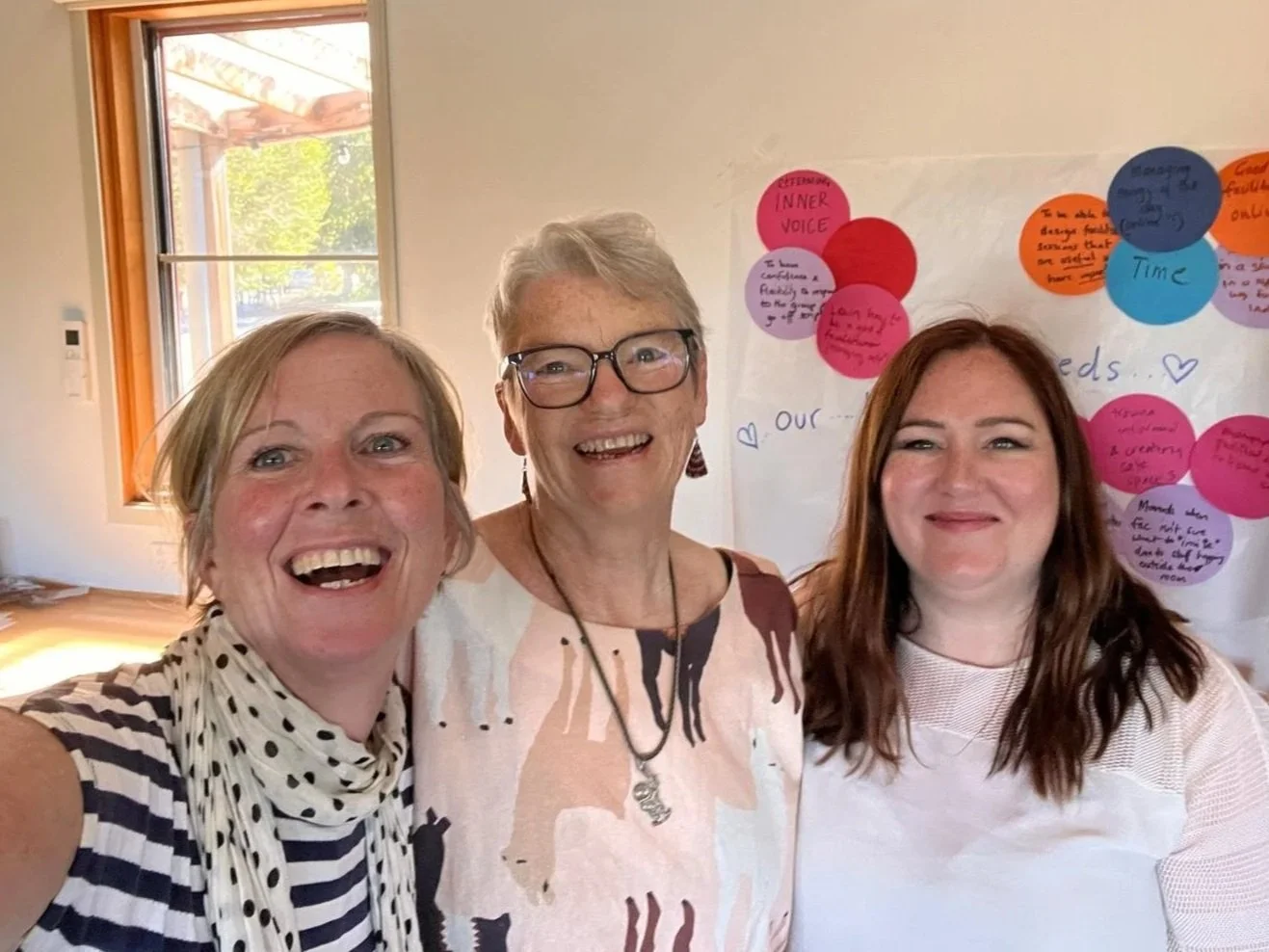
The uncomfortable realisation
In my previous roles as a team leader or workshop host, I believed my job was to steer the group. To guide the conversation toward the outcome I thought we needed.
I had an agenda. Often a hidden one.
When conversations drifted away from that agenda, I felt anxious. When someone challenged my authority or direction, I felt even more uncomfortable. I hate confrontation. When it happened, I would either retreat and shut down, or become more forceful and try to regain control.
At the time, I believed this was part of facilitating a group. Now I see it differently.
Facilitation is not control
Over the two days, one idea kept surfacing again and again: facilitation is the art of letting go.
A facilitator does not control the outcome. A facilitator trusts the wisdom of the group. The role is not to impose direction, but to support the group to move as far as possible toward its own objective.
That distinction sounds simple, but it is profound. It means stepping away from power, which can feel unsettling.
The discipline of neutrality
Another concept that stayed with me was authentic validation. Not the polite kind of validation we often perform in meetings, but genuine acknowledgement of people’s perspectives.
For that to work, the facilitator must hold unconditional positive regard for everyone in the room. They must remain impartial. They cannot secretly root for certain ideas, or quietly dismiss others.
And again, this requires letting go. Letting go of ego. Letting go of being right. Letting go of needing the group to reach the conclusion you already have in mind.
The community of selves
However, before we can let go of something, we need to first be aware of what that something is. This leads into the concept of the “community of selves.”
As facilitators, we are still human. Different parts of us will inevitably show up: the part that feels defensive, the part that wants control, the part that fears conflict, or the part that quietly judges what’s being said.
None of this makes us bad facilitators. It simply means we are human. The work is noticing which “self” has taken the steering wheel and gently returning to our Wise One.
That takes practice: recognising those inner reactions in real time, acknowledging them, and then coming back to a place of calm presence so we can serve the group rather than our instincts.
What this means for leaders
Reflecting on all of this, I can see why facilitating was difficult for me when I was leading teams. Leaders often have their own objectives to deliver, outcomes they are accountable for.
Facilitators, on the other hand, are accountable to the process, not the outcome. Balancing those two roles is not simple.
After just two days, I can see how much more there is to learn. Facilitation is not a technique you master once. It’s a discipline that requires constant awareness of your own instincts, especially the instinct to control.
But I do know this: facilitation, done well, is not about power. It’s about creating the conditions where every voice can be heard, and where groups can move forward together toward a shared purpose.
And sometimes, the hardest part of that work is learning to let go of the control you didn’t realise you were holding.
